Showing posts with label night skies. Show all posts

Saturday, October 14, 2023

October 14, 2023 Solar Eclipse

An annular eclipse graced our area on October 14, 2023. I first learned about it about a year and a half in advance, when an astronomy club from Illinois who had connections with one of my brothers reached out to me. That put it on the calendar. I thought some family was coming to visit, but plans continued changing until the last minute, when I decided to go up into the Mt. Moriah Wilderness with a couple dear friends. 

We started out at 5:15 am, which put us in a lovely spot for a magical sunrise!

Then we got to the trailhead, and to our great surprise, there was just one other vehicle there. We started hiking the two miles up to The Table.

Before we got to the top, the eclipse was starting, and we paused to put on our eclipse glasses and take a look. I managed a quick photo through my phone, with the eclipse glasses over the camera.

When we got up to the Table, it felt like we were little kids. We were giddy with excitement with all the magnificent trees, amazing clouds, and just general beauty and peace of the place.

The eclipse continued...

We ended up watching most of it from this iconic tree.

It was quite cold, but our hearts were warm as we celebrated this celestial event. 

The tree provided a nice back rest, and the clouds gradually moved out of the way.

We took a moment to enjoy the shadows on the bristlecone wood.

Trying to get a photo of the eclipse without the eclipse glasses didn't do much. The lighting looked very strange as more and more of the sun was blocked. It got colder. We heard chickadees sing right before the maximum eclipse, but it was really quite quiet up on the Table, so we didn't notice any big decrease in sound.

And then it happened! The Ring of Fire.
While it was happening, we saw two hunters hiking. Julie grabbed an extra pair of eclipse glasses and ran over to them, asking them if they had seen it. They hadn't, and were delighted to get a view.

After a few minutes, the moon continued down...

...and down (I was finally getting the hang of taking decent phone photos)...

...and down some more.

We started our gorgeous hike back...

...but paused again for another look. It was a wonderful experience, and we felt so lucky that the weather cooperated. 


Sunday, July 23, 2023

The Marvelous Night Sky - Astrophotography

The Milky Way is extra bright in summer and fall because we can see the galactic core, the center of our universe, easily. One evening, my friend Jenny and I headed to Ward Charcoal Ovens near Ely, NV. We had it all to ourselves on a calm, cloud-free night. Yay! We put a tea candle in each of the charcoal ovens and then tried a variety of photos with various light painting options to light up the ovens.

Can you see Jenny in the door of the oven?


We thought  it would be fun to put ourselves into some photos for scale. These ovens are big!


We had so much fun taking photos. When we left, we finally looked at the time and realized we would be getting home the next day. :)


Another evening I decided to check out the night life of tractors. I was a little surprised to hear some squeaking from one trailer. I guess they aren't always quiet, lol.

I was also surprised by all the green airglow. Apparently you can see it in the darkest night skies. It may also be more evident when there is more aurora activity, which is caused by more solar activity. Our sun is the most active it's been since 2002.


Another view

Then I headed down to some sunflowers. It's such a good sunflower year!


I tried for various angles, not sure what would be the most captivating. 


I could just stay out there so long with the gorgeous flowers under the beautiful Milky Way.

 Just seeing the Milky Way gets me excited. I've been wanting to learn more about astronomy, so I've gone to five astronomy programs at Great Basin National Park this summer. They're held on Wednesday, Thursday, and Saturday nights. On one off night, a couple of the astronomers offered to help Desert Boy get his telescope working properly. He had been given one but couldn't figure it out. Fortunately, with the expert help, he was soon seeing really cool objects like binary stars, globular clusters, nebula, and more.

I was having fun taking photos at the same time.

Desert Boy was even able to show some other people things through his telescope. He can't wait to use it again--but now we're in a cloudy pattern, so he'll have to wait a few nights. It won't be long until he can explore more of our marvelous night sky.

Friday, September 2, 2022

It's Sunflower Season!


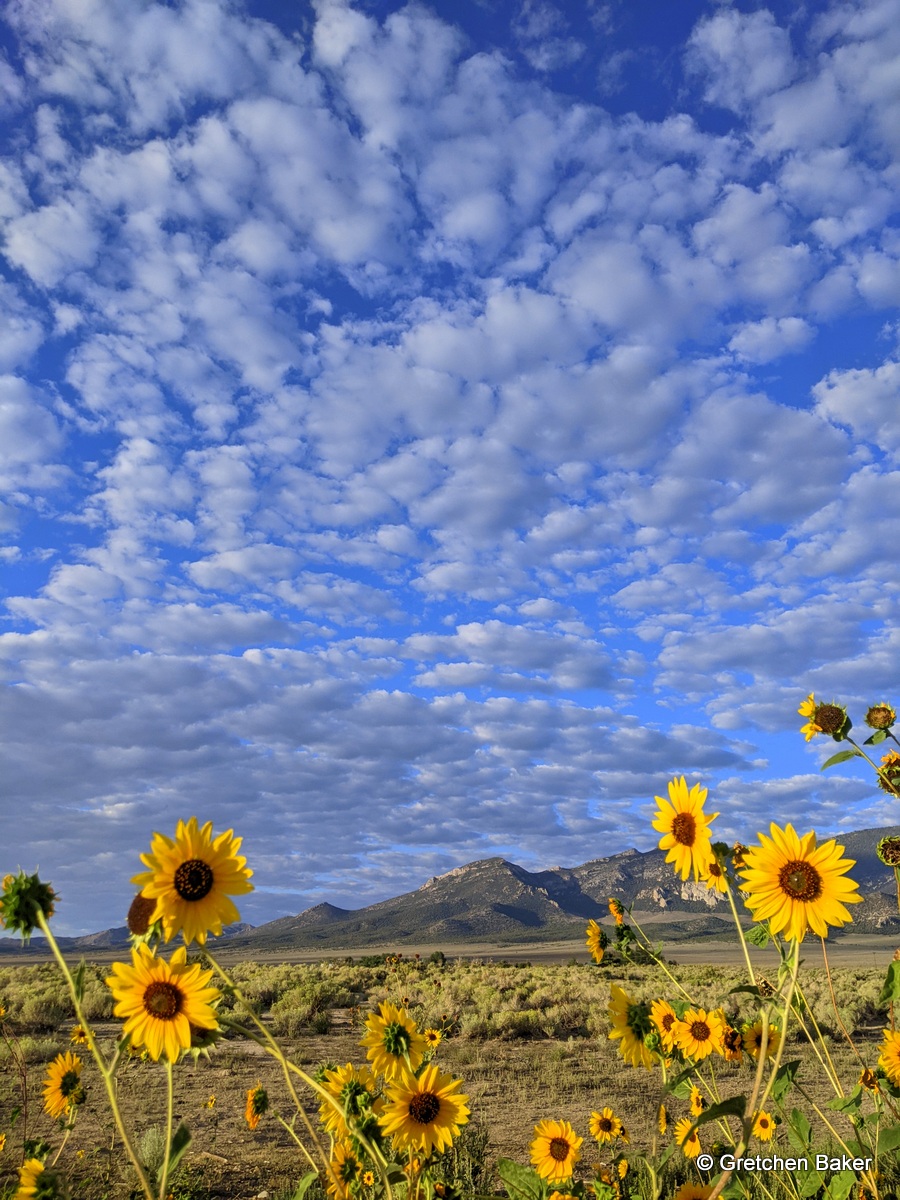
Oh my, it's been a busy summer. I'm finally getting back to my blog, and I'm going to start with an easy post--my favorite flower, sunflowers! They are blooming all over the Great Basin right now. I wouldn't normally take a lot of photos of them, but we've had some fantastic skies, like the one above, and the sunflowers make such a nice foreground contrast.

I appreciate clear skies with sunflowers, too, especially at night, when the bright Milky Way fills the sky. We're lucky to live in a Bortle Class 1 (the darkest skies), so the Milky Way is super visible here.


Sometimes I just pause to enjoy the symmetry--or almost symmetry--that can be found in a sunflower closeup.


Although sunflowers are often found in bunches, sometimes just a single one makes a stand.


One thing I learned this summer is that bees overnight sometimes in sunflowers. All the ones I've seen have been nestled into the bottom of the flower.


More cool skies. The scientific name for the sunflower genus is Helianthus, which literally means sun flower. There are about 70 species, and they are native to North and Central America. The native one here is Helianthus annuus. 


Immature sunflower buds exhibit heliotropism, where they follow the sun. But mature sunflowers mostly face east (something to keep in mind when planning sunflower photo shoots). 


Ready for more bees?

This was a different morning with gorgeous skies.


I couldn't resist trying to get a photo of the rainbow with a sunflower in it!


Finally, another nod to sunflowers under the Milky Way. Life is good.
If you have a favorite sunflower shot, I'd love to know! Thanks for taking a look at this post.

Sunday, June 13, 2021

New Astronomy Amphitheater at Great Basin National Park

Great Basin National Park has been building a new astronomy amphitheater, and I recently got to experience it. I went to the very first program, on a Tuesday night near the end of May.

Ranger Charlie did a fantastic program, weaving together stories about the Forgotten Winchester rifle, the amazing dark sky, and what we can do to see into the distant worlds better.

Following the program, the rangers got the telescopes focused on objects. Because it was the first program of the year, this took a little while.

This gave me some time to walk around the amphitheater. It's lit with red lights to preserve your night vision. The lights are dimmable, so they can be brighter before and after the program and dimmer during.

The mountainous backdrop is gorgeous, and the amphitheater is situated so that you shouldn't see car headlights. Parking is at the Lehman Caves Visitor Center, and then you walk down the road to the picnic area to the amphitheater. It's best to arrive 15 minutes before the program start time to allow for this. In addition, the capacity is 200, and the programs this past week had over 175 people, so it's possible that some people may have to be turned away in the future.

While we waited, Charlie pointed out some of the first things we were seeing appear in the night sky. It's fun to see the stars start off few and far in between, and then before you know it, they are dancing across the sky in a packed arena.

Two telescopes were being set up that night. It was also the night of a full moon, so the first place to look was the moon. If you've never gotten a close up view of the moon and its lava fields, it is an amazing sight.

It's also a bit blinding, as the moon is so bright!

With the telescopes situated, it was time to line up.

Everyone was really patient.

After each person got a view, they went to the back of the line. Once everyone saw the moon, it was on to the next night sky object.

The astronomy amphitheater is a great addition to the park, and I highly recommend attending a program. They are on Thursday and Saturday nights throughout summer. In June and July they are at 8:30 pm, and then starting in early August change to 8 pm. 

When it's time to go, you follow the red lights back to the parking lot. There are even stars on the road, what a nice touch!

Great Basin National Park is an International Dark Sky Park, and now there's an effort to make the gateway town of Baker into the first Dark Sky Community in Nevada. 


At the Farmer's Market on Saturdays (next to the church in Baker) there's a fundraiser to help with this effort. A local who has made a variety of beautiful glass has his entire collection being sold off.

The glass takes so many forms, some I had never even seen before.


Hopefully the exceptionally dark skies out in this remote part of the world can be saved. And here's hoping we can restore the dark to many other parts of our world. This is a solvable problem, and better lighting benefits us all. 
If you like astronomy, I hope you get a chance to visit the new astronomy amphitheater. For more on Great Basin National Park's Astronomy Program, check out their website. 
Related Posts Plugin for WordPress, Blogger...

blogger templates