Friday, September 5, 2014

Hiking with Kids-North Schell Peak, Nevada

My husband and I will soon be off on our tenth anniversary trip. We decided to climb Mount Rainier, at 14,410 ft. To prepare, we decided we should hike one mountain peak a month, and we've amazingly been able to stick to that training plan.
In April we hiked Crystal Peak, 7,108 ft, 2.5 miles round trip, a few hundred ft elevation gain.
In May we hiked Wheeler Peak, 13,063 ft, eight miles round trip, about 3,000 ft elevation gain.
In June we hiked Mount Moriah, 12,050 ft, 7.5 miles round trip, about 2,000 ft elevation gain.
In July we hiked Pyramid Peak, 11,998 ft, 8 miles round trip, 3,900 ft elevation gain.
And in August we hiked North Schell Peak, 11,883 ft, 6 miles round trip, 2,800 ft elevation gain.

Here's the story of the North Schell Peak trip, a peak I really enjoyed.

The night before we stayed at the Timber Creek campground. Since it's not far from Ely, we fully expected it to be full, but only two other campsites (of about 11 there) had tents up. Each site had a concrete pad, fire pit, picnic table, and lots of space. Potable water and pit toilets were nearby.

It was a chilly night, and we woke to frost on our packs. So we got up, left the tent in place, drove to the end of the road, and started hiking. We followed an old road through the aspens.

The old road followed Timber Creek as it curved to the north. The scenery was gorgeous.

The trail climbed steadily along the drainage. I hadn't even expected a trail so far up, so was very pleasantly surprised. The creek went dry, but we did find an occasional spring.

I even found a few ferns in a cool, moist spot.

And also a deer skeleton. Even though it's bow season, we didn't see any hunters.

The trail petered out as the creek bed merged into alpine slopes. We stopped for one of many snack breaks and snapped a quick family photo (I've learned not to wait until the top!).

Then we knew we just needed to go up. A gentle ridge beckoned us.

The lupine was still blooming, although some seed looked ready.

We found some wood up high on the slope, above any trees, indicating that the forest used to be up higher on the slopes.

Although Desert Girl was carried for about 500 ft elevation gain, she did most of the hike. One technique that was particularly effective was for her to share her dad's hiking poles. When he moved a pole forward, that helped propel her forward.

Desert Boy was charging ahead to the summit, except that what he thought was the summit was a false summit. It was a hard lesson to learn. Fortunately the bribe of pizza after the hike helped rekindle everyone's spirits. Plus as we got higher, the scenery was so dramatic.

Finally we only had the last ridge to climb, past the small wind shelter.

I got distracted by the alpine plants, which are so diminutive due to their short growing season and harsh conditions they have to withstand.

When I looked up from photographing plants, I saw my husband and kids making good progress.

The ridge had looked so sharp from below, but was not at all hard to hike up. We were glad we had our coats, it was cold!

And then we were there! Even our dog Henry made it.
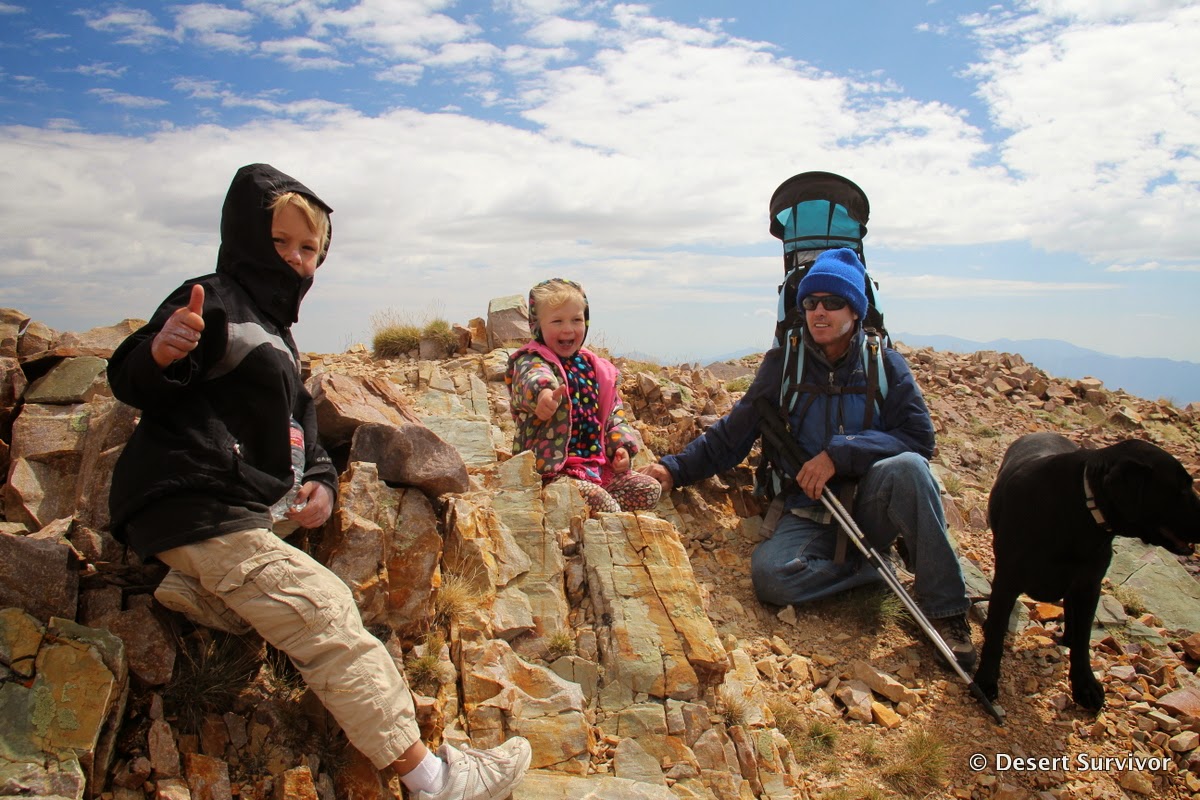

Of course the top isn't the end of the hike, it's only halfway! We still had to get back to the vehicle. We debated going back the way we had come (which would have been a good idea and easier) or following the ridge and taking the straight line down. Since we seem to be suckers for taking the hike less traveled, we followed the ridge.

A huge group of ravens hung out in the leeward side of a saddle.

The buckwheat was beautiful.

Someday I'd like to hike a lot more of the crest. The Schell Creek Range is 142 miles long. I don't think I need to hike all that, but a few more miles would be beautiful.

Can you spot the people? We didn't see anyone else on our entire hike. The register from mid-July had seven people signed in. Nevertheless, North Schell Peak is a popular peak with those wanting to hike peaks with greater than 5,000 feet prominence. (Here's a list of ultra-prominent peaks in the lower 48).
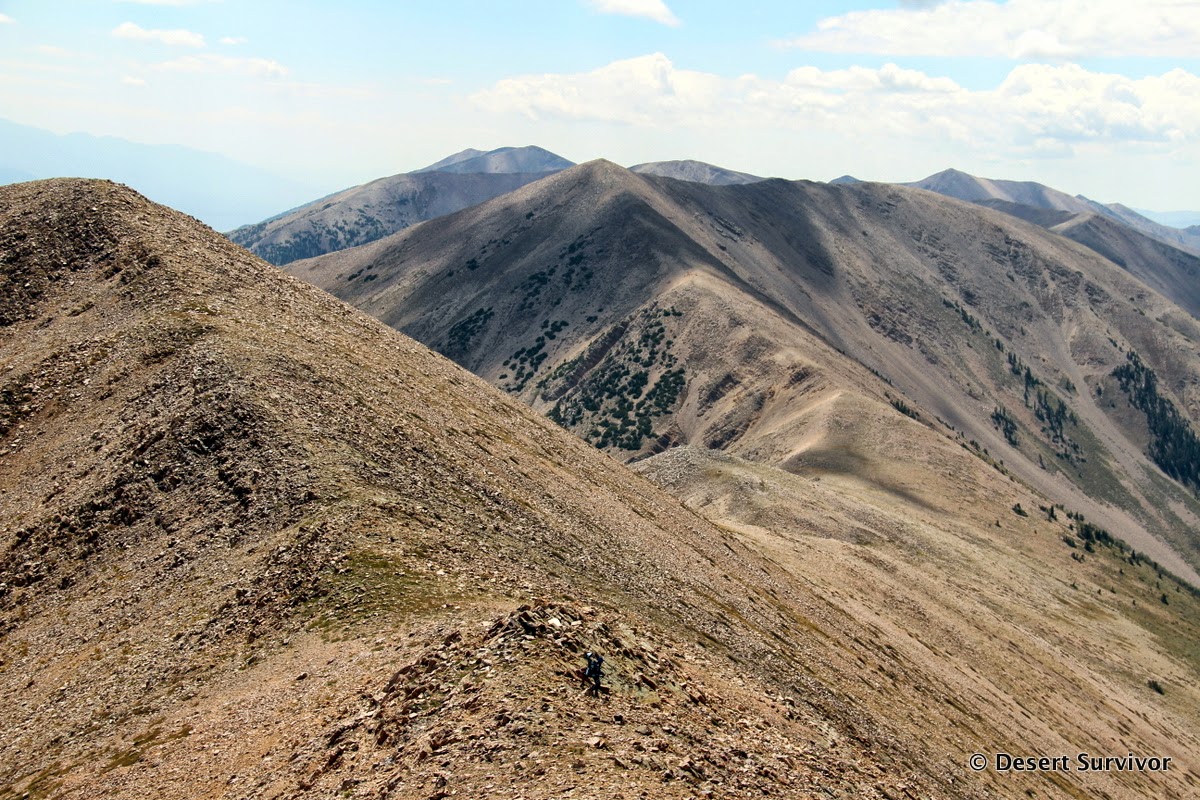
It was blustery on our way down.


Although the landscape views are superb, I like taking in the little details, too, like the little wasp. It had a variety of flowers to visit.

Some of the quartzite rocks had interesting patterns in them.

And here's a pretty butterfly.

The scenery was absolutely spectacular. Have I mentioned that already? I know that I certainly never pictured Nevada looking like some of it does. The Basin and Range topography makes for a huge diversity of habitats.

Before long we reached a huge aspen grove, with most of the aspens bent due to winter snows.

It took us four hours to get up and about 2.5 hours to get down, with a round-trip total of close to six miles. It could certainly be done faster if you didn't need to take as many snack breaks!

Before we left the canyon, we had to stop at the playground. Yes, Timber Creek campground has a playground!
I hope to get back to the Schell Creek Range to do some more hiking. It is gorgeous and uncrowded.

Wednesday, September 3, 2014

National Cave Rescue Commission Camp Goldenbell, Colorado

If you've been reading this blog for any length of time, you know I like caves. Early on in my caving career, I became friends with some cavers who also were into cave rescue. They got me interested, and over the years I took enough classes (four eight-day classes to be exact) plus helped with many smaller cave rescue classes (also known as Orientation to Cave Rescue (OCR) classes) that I was permitted to take the test to become an instructor. Over the years I've instructed a variety of classes, and this year I was able to help instruct the Level 3 class at the national seminar for the National Cave Rescue Commission (NCRC). It was held in May at Camp Goldenbell, Colorado. (I think I mentioned before I was a little behind on some posting!)

It was my first time to help with the Level 3 class, which is more technical than the previous classes. Students had to pass various technical skills in order to be able to get into the class, as well as have had the Level 1 and Level 2 classes within a certain time period. We had a full class with a waiting list, and it was a great class! To see just how well they knew their stuff, one morning they were challenged to some knot tying. But not regular knot tying. This was with your eyes closed, or with just one hand, or behind your back (photo above), or with oven mitts, or with a partner. It was fun for everyone.

Soon it was time to head out to the cliffs to evaluate their skills and ability to work together. We did some basic anchors and hauls and lowers.

They did very well with all of that, so then we gave them more challenging problems. The colorful accessory cord and rope make it easier to tell what's going on in the photo below.

Everyone should be a pretend patient at some point, as it's a very strange feeling to be dangling on a rope, swinging in a basket.

The students were doing so well that we decided they needed one final challenge: to go down a boulder, through a hole in it, and up the other side. This would require the whole class (which had previously been split up) and be a communications challenge. The down and through part went smoothly.

 The up part was the most complicated. Here's a view of the litter still horizontal.

Then it was shifted to vertical. Then there were problems with some torque issues on one high anchor and some pre-tensioned (or I guess in this case, post-tensioned) backties were added at the last minute. And they succeeded in getting the patient to the top of the boulder again.

Since it was a cave rescue class, we wanted to spend as much time in caves as possible. The caves we had to work with didn't have large work spaces, so we split the class into three smaller groups and they had a variety of tasks to do, such as counterbalances, traveling hauls, and tensioned traverses. (If you want to know more about these things, in addition to taking NCRC classes, the books On Rope and Alpine Caving Techniques are very helpful). My camera didn't do great in the cave, so I didn't get as many photos of our cave days.

I did get a lot of photos on our highline day, when we sent a rescuer out to the middle of a gorge, then down to the river to pick up a patient, and back to the shore using a Norwegian Reeve.
 Can you see the rescuer?
After that very gear-intensive and long exercise, they were challenged to get me (wearing my harness) from one side of the river to the other using only two ropes and six carabiners. They did it in less than half an hour. Sometimes less gear makes things go a lot faster!

Then came the mock-mock day. We used part of Cave of the Winds for the exercise. All four classes (Levels 1, 2, 3, and TOFE) came together, and then were split into three mixed groups. I led one of the groups with a cadre of excellent instructors to one part of the cave, where we put on four mini-scenarios so everyone would learn more about how to launch a cave rescue and how to participate in various roles, such as communications (using old army phones, as seen below).

Finally came the culmination of the class: the mock rescue. This is an all-day event that the students solve with minimal instructor interaction. My role was to be entrance control for instructors going in and out of one of the caves used, plus to check the rigging used to take the patient from the cave entrance to the canyon bottom many hundred of feet below. It was a great spot to see people as they came to the cave.

The rigging was very nice, and after many hours, the patient was brought out of the cave and then taken down to the canyon bottom. The only problem was that a for real big storm came in, and the canyon is subject to flooding. So before everything could be derigged, we got everyone out of there as fast as we could. Some went up to the parking lot where we had started, others went down out of the canyon on a faster trail. But then they closed the roads for hours, and the two groups were stranded, bringing some real logistical challenges. The Colorado cavers did a super job of sorting it all out, and everyone got back to camp safely in the wee hours.

It was a super experience checking out the Colorado cliffs and caves. The students I talked to got a lot out of the class. Next year the national NCRC class will be held in Park City, KY from July 24-Aug 1. Other NCRC classes will be held throughout the year in various locales. If you like caving, I definitely recommend a cave rescue class, as it will make you cave a little differently--hopefully safer!

Monday, September 1, 2014

Hiking with Kids: Wheeler Cirque Bristlecone Grove

As I've mentioned in a previous post, I've had bristlecones on my mind a lot this summer. One of my trips up to see these old, high-elevation trees was back in early July. There's a lovely bristlecone grove accessible via a 1.5-mile (one-way) hike in Great Basin National Park, along the aptly-named Bristlecone Trail. We decided it would be a great destination for six kids and four adults. But before we started, we had better stretch!

One of the keys to having kids enjoy the hike is to make it a game. Apparently balancing was a major part of the game, because as I looked back at the photos, I saw the kids were really enjoying it.


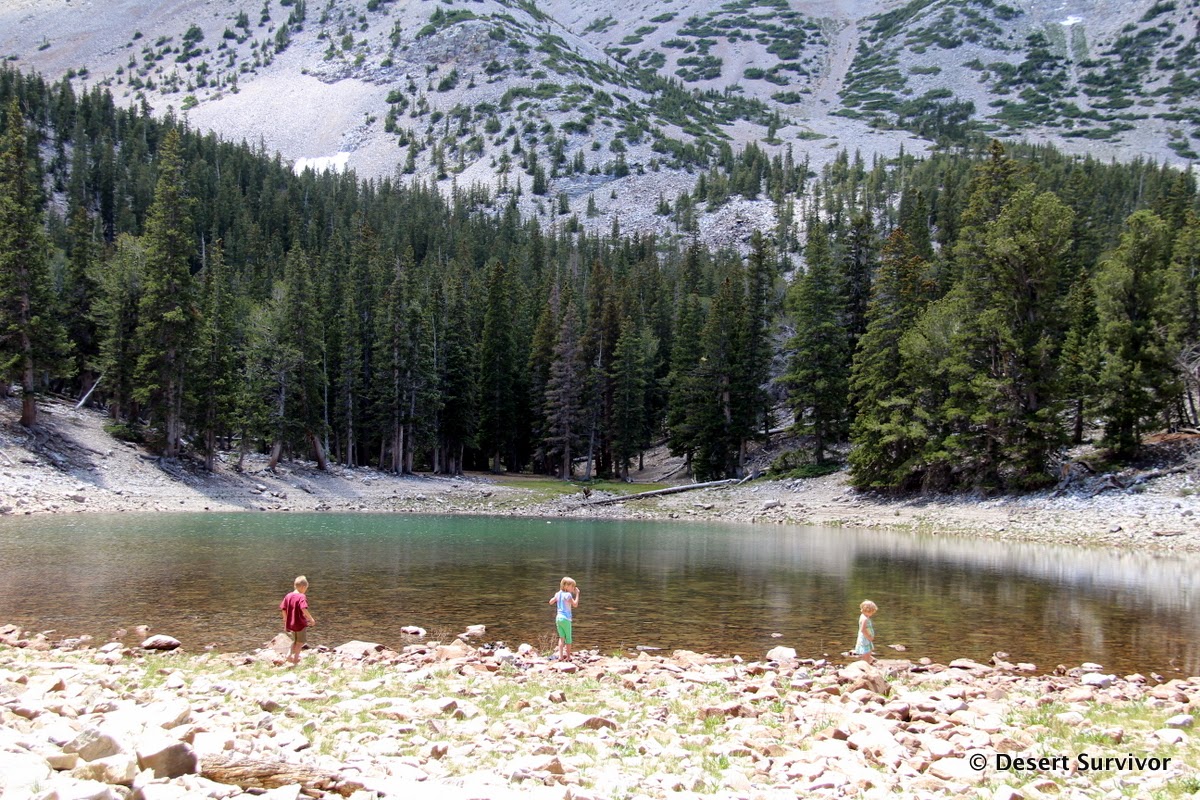
We had planned to eat lunch at the bristlecone grove, but based on the level of whininess (that's a word, right?), we adapted and changed our plans to eat lunch at Teresa Lake (0.7 miles from the trailhead, or about an hour away at our speed). Water is always appealing to kids, especially when we told them they could go swimming! They quickly figured out that it was very cold water for swimming, but that didn't stop them from hanging out at the edge.

Rested up and fed, we continued our hike to the bristlecones.

Meeting up with Ranger Carolyn provided a nice rest break and photo op.

The trail is stunning, with great views as you get closer and closer to the glacial moraine where the bristlecones live on the Prospect Mountain quartzite (most old bristlecone groves live on dolomite or limestone, so this grove is a bit different).

Heading up a switchback.

And then we were there! We saw cool bristlecones all around.

The kids weren't interested in the bristlecones, but instead the prize we had promised: doing their nails. Whatever it takes!

I left them to walk the short interpretive trail and visit some trees over 3,000 years old. One of the oldest trees in the world, Prometheus, at about 5,000 years old, was found near here, but many scientists think it was an outlier, as they haven't been able to find any others in the area over 4,000 years old. Nevertheless, living 3,000 years is still amazing. And once a tree dies, its wood can remain intact for thousands of years more.

The reason that bristlecones can live so long is that most of the tree dies after time. A narrow strip of bark supports just a small section of life on the tree. Meanwhile, wind and precipitation shape the remaining dead bark into fascinating forms.

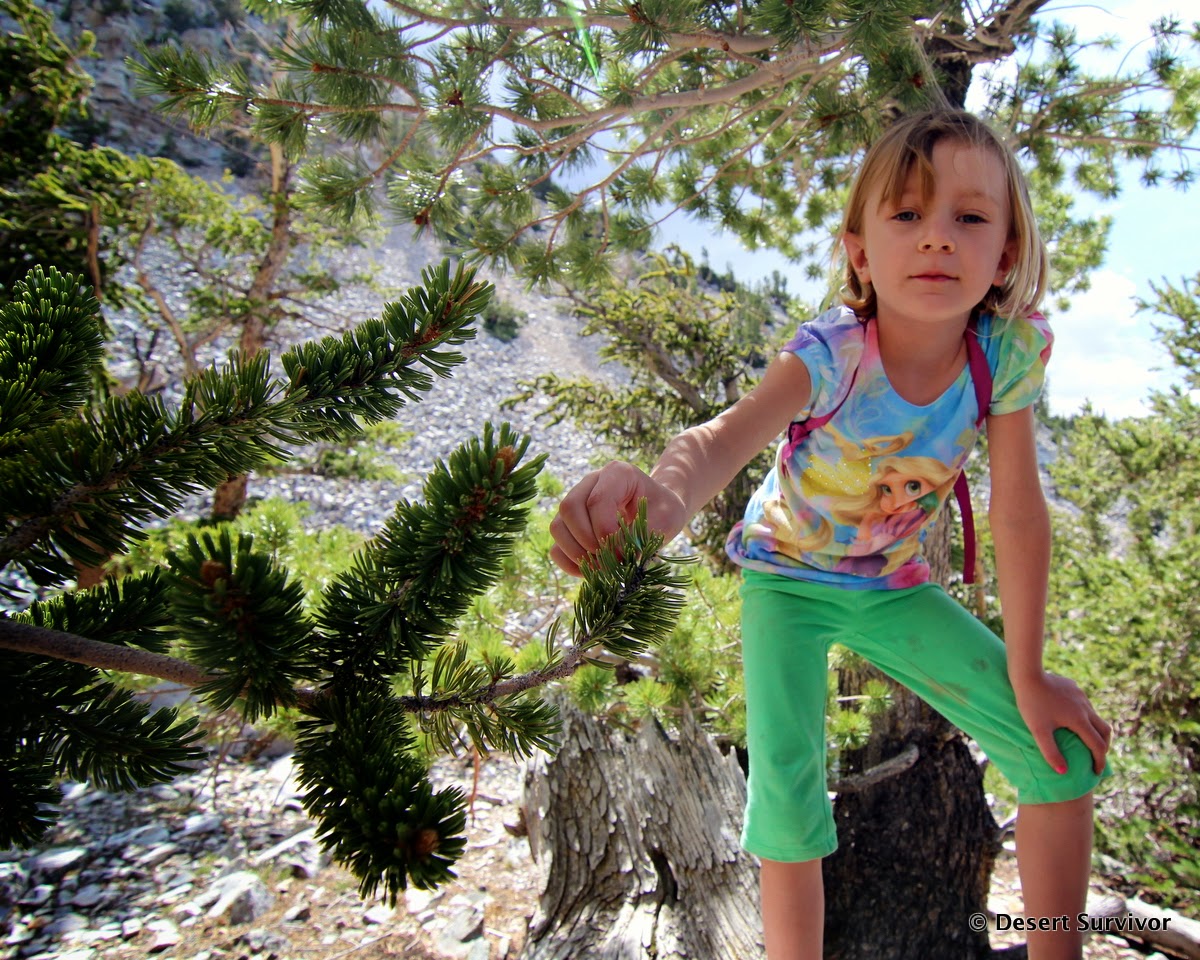
Although the kids weren't interested in the interpretive trail, they still did think the bristlecones were pretty cool. They took time to touch the needles, which can remain on the tree up to an amazing 45 years.

After a big snack, it was time to head back. We had another motivator: ice cream at the Lehman Caves Cafe. But we had to move fast to make it in time.

Fortunately we got there about five minutes before closing and they were kind enough to smile and make something for all of us. That sure put smiles on our faces! What a great hike.

Related Posts Plugin for WordPress, Blogger...

blogger templates