Monday, April 15, 2013

An Irrigating Trip with Some Beautiful Birds

 My husband had to do some irrigating Sunday afternoon, so we went out to enjoy the pleasant afternoon and have some outside family time.

 Desert Boy gingerly crossed one of the irrigation ditches, making sure the water didn't overtop his irrigating boots. He wasn't so careful later and had to dump the water out of his boots!

 Meanwhile I was going crazy because I saw some really fun birds out in the wet meadow. An American Avocet caught my eye, with its reddish head and black and white body and wings. It's long legs and bill make it well-adapted for the marshy environment.

 Nearby was a bird with a similar shape, but its legs were red and it had a body that was just black and white--a Black-necked Stilt.

I particularly liked seeing the reflection of the bird.

 
Looking east, it still looked sunny and calm as the water flowed from the irrigation ditch out across the meadow. Behind us, up in the mountains, the storm clouds were gathering and darkening the sky. Soon the wind would begin and the temperature would dip several degrees. The joys of fickle spring weather--you can have everything from summer to winter in just a couple hours!

I tried sneaking up on some Long-billed Curlews, but they didn't really want me to get close. They have such long bills!

 Henry was busy watching my husband work. He's a good dog like that. He knows how to conserve his energy.

 Of course, I shouldn't really talk. I wasn't working. I was having a terrific time wandering around taking photos.

A couple mallards took off. My husband noted that he's seen thousands of birds recently in the wet meadows and wetlands. Spring migration is well on its way, and many birds are stopping for a well-deserved meal on their way north.

 Besides birds, I also spotted some old equipment out on the meadows. I have no idea what this was, but it sure looks like it has been there a long time.

 Another shot of the meadows. This was the first place settled in our area because of the abundant water. We're hoping that the water will stick around and not be piped away, as it's critical to our ranch plus it's clear that a lot of wildlife depends on it.

 These dandelions in the mud next to the ditch made me crack up. They were in such a rush to flower and reproduce they barely made time to make any leaves.

 One more bird--White-faced Ibis. You can barely see the white near the eye.

I don't get to see any of these birds everyday (although I do see mallards at least once a week), so I was on a birding high. Even though none of these birds were a new species for me, just seeing them again made me feel reconnected to nature. Things must be going well for them at their southern homes, and hopefully they will be successful breeding in their northern homes. Seeing these international travelers makes me feel just a little bit flighty!

Saturday, April 13, 2013

Mojave Desert Spring Wildflowers

I had the chance to check out some Mojave Desert wildflowers this week, not far outside of Las Vegas. It's the best wildflower display I've seen so far this spring. Apparently some spring thunderstorms dumped at just the right time. 

Here's a sampling of what I found while wandering around for about ten minutes. I wouldn't have minded spending a lot more time wandering--all those colors in the desert are such a wonderful show!
 Many of these beautiful yellow Desert Marigolds (Baileya multiradiata) dotted the roadsides.


We may appreciate their beauty, but many insects rely on these plants to survive. 

The globemallow (Sphaeralcea ambigua or coccinea) is a favorite of mine, with its orange blossoms. You don't see too many orange flowers!

 The creosote bushes (Larrea tridentata) are blooming, with tiny yellow flowers contrasting with their dark green leaves. Creosote bushes grow in some of the driest and hottest regions in North America. They are an evergreen, coping with drought by having highly varnished leaf surfaces that reflect sunlight, along with resins in the epidermis that can help seal the leaves against water loss. In order to avoid being eaten, the plant produces chemicals that make it undesirable. It's one of the few members of the Caltrop Family (Zygophyllaceae).

Another favorite is the Desert Trumpet (Eriogonum inflatum), so named because the stem bulges. If you look really closely this time of year, you can find tiny yellow flowers.


The lines on my fingers give you a sense of scale of just how tiny the desert trumpet flowers are.

Another plant with tiny yellow flowers is Mojave Ephedra (Ephedra fasciculata), closely related to Mormon Tea. The plant pictured above is a male bush--the female ones have different shaped flowers. I should mention that these technically aren't even flowers, they are small cones. Maybe I shouldn't mention that, because we should just enjoy their beauty!
(By the way, I didn't realize I had a smudge on my lens until I downloaded these photos. Sigh.)


Even from the road driving along at 70 mph (which was the speed limit), I could see the bright pink of prickly-pear cactus (Opuntia sp.). I adore flowering cacti--it is such a strange juxtaposition to see the delicate flowers on the spiny pads.

I think my heart quickened every time I found another cactus blooming. I don't think I could ever get tired of them.

As I wandered over the gravelly and sandy soil, I found little glimpses of color here and there from flowers that weren't nearly as large.
One was scarlet guara (Guara coccinea) in the Evening Primrose Family (Onagraceae). This perennial herb can grow up to 3 feet tall and has a mix of white and red flowers on a narrow raceme.

Mojave Yucca (aka Spanish Dagger; Yucca shidigera) played a center stage out on the desert floor, with two-foot tall inflorescences extending from a rosette of dagger-sharp leaves.

The flowers can be 1 to 2 inches across. Mojave yucca is the most common yucca found in the North American deserts. California Indians gathered and roasted the fruits and used the fibers extracted from the leaves for making blankets, baskets, and ropes.

I had to also stop for another member of the Lily Family:
The Joshua tree (Yucca brevifolia). These are also blooming right now. I love these trees and their strange shapes;  seeing the flower clusters, plus some late afternoon sun on them with storm clouds brewing in the background made we wish I could hang out for hours. I'm afraid my photos didn't do them justice--oh well, I now have a good excuse to return!

Joshua trees are pretty much limited to the Mojave Desert (see little map in the sidebar and click on it to learn more about the four deserts in North America). Birds, rodents, lizards, and other animals all use these trees for a variety of purposes, including shade, food, and shelter.

Kudos to Ronald J. Taylor and his book Desert Wildflowers of North America, which helped greatly with this post.

Now go out and enjoy some spring wildflowers, where ever you are (and if you're south of the equator reading this, consider it an invitation to come visit!)

Wednesday, April 10, 2013

A Little Rock Climbing

 We happen to live less than an hour away from a world-class climbing destination, Ibex. On Sunday, we decided to make a trip out there. I dusted off my climbing gear. Back when I was in grad school, I climbed three days a week in the climbing gym and occasionally outside, but due to a long hiatus, I was feeling rusty. Very rusty. We had the book Utah's West Desert, which is an awesome guide to rock climbing, and which had inspired me. I found a route that was for kids. It was also a sport route, which I needed, as I don't have trad gear.

For those not familiar with rock climbing, sport climbing means you clip into bolts already placed into the rock, and you need less gear: rope, quickdraws (carabiners connected to a short piece of webbing), harness, and ATC. Trad (traditional) climbing has no anchors, so you have to have an assortment of nuts, camalots, and other gear that gets pricey fast, but lets you climb about anywhere.

We weren't entirely sure we had reached the climbing place we were searching for, because instead of two bolts we found a whole array of bolts. It was obvious this area is developing and people are putting up new routes. I decided we would play it extra safe and top rope. I scrambled up to the anchors at the top of the climb, threaded the rope through, and sent it down below. With top roping, as long as your belayer is awake, you won't fall more than a couple inches. Perfect for us novices. I climbed first and decided we definitely weren't on the easy rock the book described. I struggled a little, but eventually made it to the top.

Then it was time for Desert Boy to climb. He did a good job climbing, but said he felt a little scared.

When he got down, Desert Girl couldn't wait to give it a try. She did quite well, but wasn't too comfortable coming back down.

Even though it was a cool spring day, it felt hot on the rocks. I climbed again, then we packed up. I wandered down the cliffs to see what some other climbers were doing.

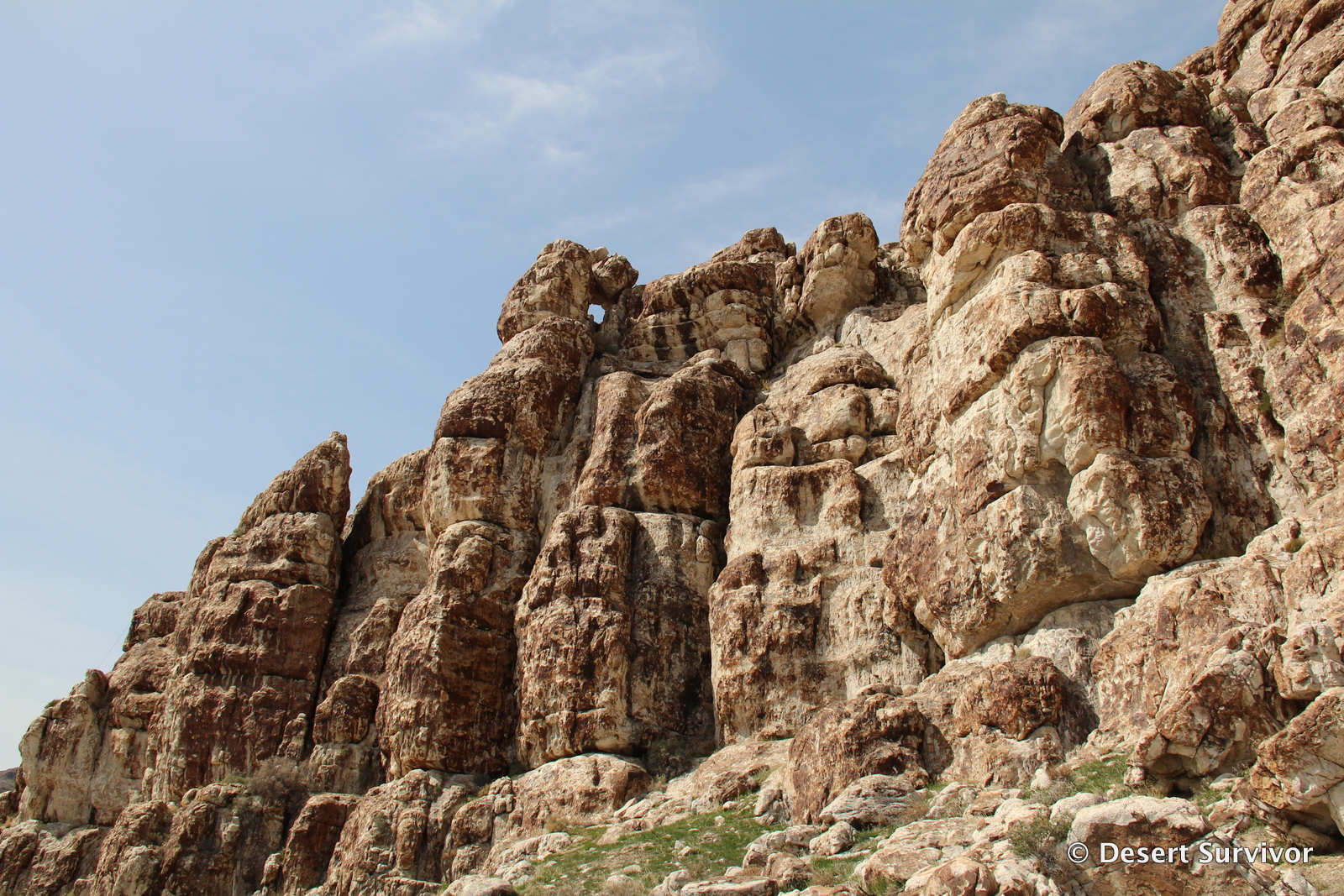
The rock looked beautiful!

I was happy to see some colorful milkvetch (Astragalus) blooming.

A rock wren hopped along the cliff, following me and serenading me.

This yellow member of the Carrot Family (Apiaceae) also lent some color to the desert floor.

It was a busy day at Ibex, with about ten other people there.

We were hungry and hot, so we went to the shade of the Red Monster (seriously, that's the name of the huge boulder!) and set up for a picnic lunch.

While the soup was warming, the kids and I some time to do a little bouldering. We all loved that.

Desert Girl conquers the boulder!

After lunch we felt reenergized and headed off for some more desert adventures, although not quite as fast as the pronghorn who ran in front of us on the hardpan.
I loved the feeling of climbing again, and we will be back to Ibex soon. Hopefully we will have better luck finding some really easy routes for the kids to help them build their confidence and skills.

Sunday, April 7, 2013

A Little Hair Adjustment

 Desert Girl got creative with the scissors the other day. From the front, it wasn't instantly obvious (although note the varying length of ponytails on the right).

 But from the back, it was obvious she had gone a little overboard.

To make things worse, she cut even more the next morning!

Fortunately my friend Chandra was able to come over and do some emergency repairs.

Desert Girl didn't look too certain at the beginning of the haircut.


Chandra had her work cut out for her.

 Desert Girl has been well-trained by her babysitter to sit still to have her hair done, so she was really good for Chandra. By the end of the haircut and a few praises later, she was cheering up.

 All done! And very cute!

 Oh, my little girl is full of spirit. Her new haircut matches her attitude.

Time will tell if she's learned her lesson of not cutting her own hair!
Related Posts Plugin for WordPress, Blogger...

blogger templates