Monday, August 15, 2011

A Walk to the Lakes

On Saturday we joined some friends to do the lakes loop trail. It starts at nearly 10,000 feet elevation and is about 2.7 miles long. Our goal was to make the three- and four-year olds walk the entire way.

The first destination was Stella Lake, and although Desert Boy is usually a good hiker, he didn't eat enough for breakfast and complained almost all the way there. I was wondering if we were going to make it!

Fortunately we did! The photo above shows some of the historic dam that was built to increase Stella Lake's capacity.
It was warm and we wanted some shade and other hikers had claimed spots in the nearby shade, so we decided to go for an "adventure walk" and go to the other end of the lake.

The clouds were so neat!

We finally made it and found a nice spot under these Engelmann spruce. I had visited them in April and May to put a camera up to photograph the lake and help determine when the ice melted off it. Do you see the camera in the photo? Look about halfway up the bigger tree on the left. Yep, it was 15 feet off the ground. I managed to climb up to it, but I didn't have a very good purchase so couldn't stay there long.

Meanwhile the kids were having fun seeing how far they could wade into the lake before they got yelled at. Fortunately they could be redirected by throwing rocks in the lake. Then it was a game of throwing rocks while you were as close to the lake's edge as possible (or in it).

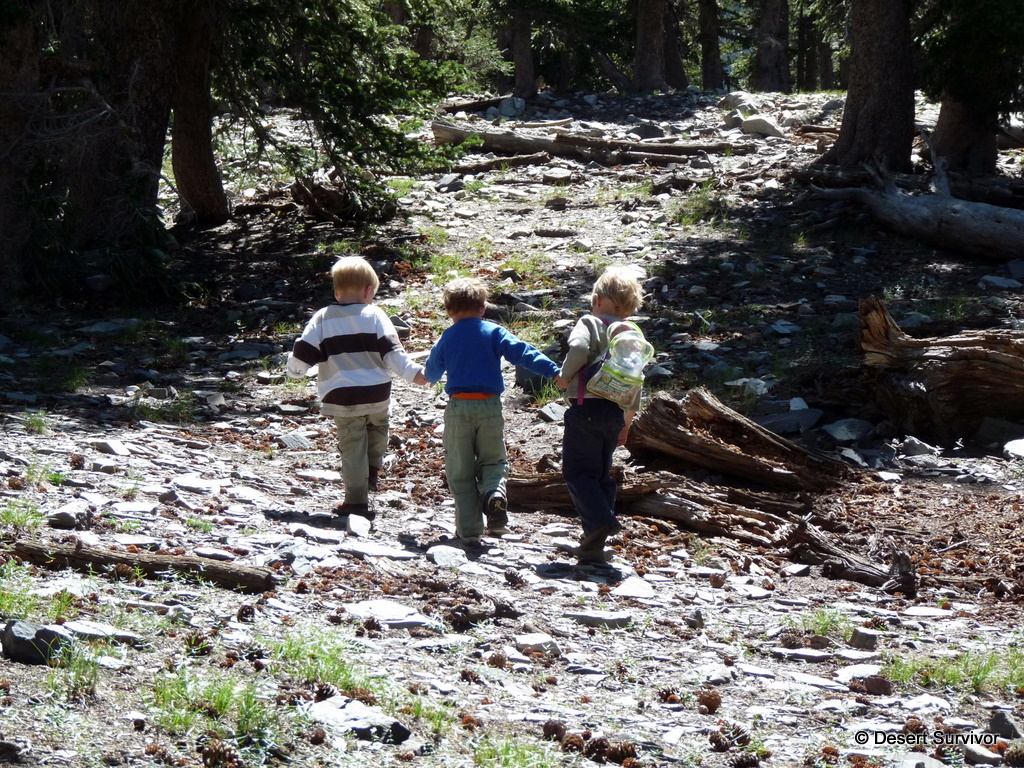
After consuming copious snacks, the munchkins were ready to continue. They were oh-so-cute as they joined hands and headed up the hill.

Desert Boy had chosen to wear one of Desert Girl's socks, which wasn't working out so well for him. Charlie didn't mind an extra stop.

Desert Girl loved hiking with Nomi. She held her hand for a long way.

We found lots of trees that had fallen, and the kids liked looking at the roots. Even though the trees are so tall, they sure have shallow roots!

Desert Girl liked hiking the downhill bits best.

Then it was time for another adventure--crossing a log over a small stream.

This led to another camera high up on the tree.

It was overlooking Teresa Lake. I had never seen it so high and aquamarine-colored in August as that day. It was absolutely gorgeous.

The datalogger we have in the lake and are scheduled to get the end of September might only be reachable by snorkeling. I'm not sure if any one is ready to volunteer for that!

After more snacks, it was time to go again. Charlie liked driving his motorcycle down the trail. Desert Boy interrupted the normal forest noises with his loud train whistle. Brandon was the best hiker, never complaining. All of them hiked the entire way.

When we got back, the kids found instant entertainment in the water fountain. Even though we hadn't let them swim in the lakes (which they wanted to do), they found a way to get soaking wet!

Friday, August 12, 2011

Caption Ideas?

This is what Desert Boy chose to wear one day this week. I didn't know what to say. I'm not sure he did either. I think he has on two different shoes because he couldn't find two of the same kind, but I'm not totally sure. His clothes are on backwards more than frontwards, but somehow he managed to get the shorts on sideways. And he really likes to dress up, hence the turtle tie.

If you have any insights into four-year old thinking, please share!

Monday, August 8, 2011

Things in Caves

 I've been lucky to go on some caving trips lately, often with a biological focus, so I couldn't resist testing the limits of my cave point-and-shoot. Above and below are a pseudoscorpion, Microcreagris grandis Muchmore. They're the top of the food chain in many of the area caves.
 And they're only about a half-inch to an inch long. Such an ecosystem, where the top predator is smaller than the size of a quarter!
 Deb and Gerry helped me download data loggers along with place bait. They hadn't done much caving but were amazingly agile and moved without any problems.

 This tiny spider was really, really tiny, like about 2 mm long.

 My caving group after the cave trip. Notice how clean they all look. We visited a clean cave. (Spoiler: muddy cave to come.)

 This is a dipluran, and we may never know the species unless someone decides to become a dipluran expert and take on some work describing new diplurans! (Young readers, please take note of this. If you're the only dipluran expert in the world, you could get a lot of work heading your way.)

Notice what the dipluran is on--wet, gooey mud.

If you're wondering if this is a different cave, you're right!

 The above photo really isn't of nothing. In fact, there are five cave critters captured--a mama and four little babies. The babies are less than 1 mm long (very sorry for mixing English and metric systems, I end up using both for work). They are Arrhopalites springtails, and I watched them jumping on the surface of the water.

 Those Arrhopalites springtails were on the top of the water, but at the bottom of the little puddle was a white planaria. Maybe we can find someone to identify it.

Anyone know any planaria experts?

It would take a special kind of person to be a planaria expert.

Just saying.

 Phew, on to something almost warm and cuddly. At least it's bigger than two inches long and easily seen. This is a harvestman, this species only found in caves, and a relative of Daddy-long legs. It belongs to the Opilionid family, which means it is a cousin to the spiders (Arachnid family).

 So long, harvestman!

 No cave life in the above photo, but something surprising--running water in this cave! I had never seen that in this part of the cave, and I was terribly excited. The cave wasn't sumped, so we could follow the water and see a cave forming process in action!

 Nicole and Jennie negotiating the mud slope down to the water. See, I'm not the only crazy one who enjoys getting covered with gooey mud in a cave!

 We headed downstream, towards the canyon passage. The water was moving swiftly. We had rubber boots on, but we managed to find a pool deep enough that we all flooded our boots.

Then the water sounded louder, and we rounded a corner and found:
 a waterfall! Sweet! A two-foot waterfall in the cave. We saw the water continuing down into the narrow canyon passage and chimneyed above it for a bit, but it was apparent that the rest of the cave was sumped and the walls were extra slippery, so we turned around and headed back.

 On the way I spotted this little cave-adapted millipede, Idagona lehmanensis Shear.

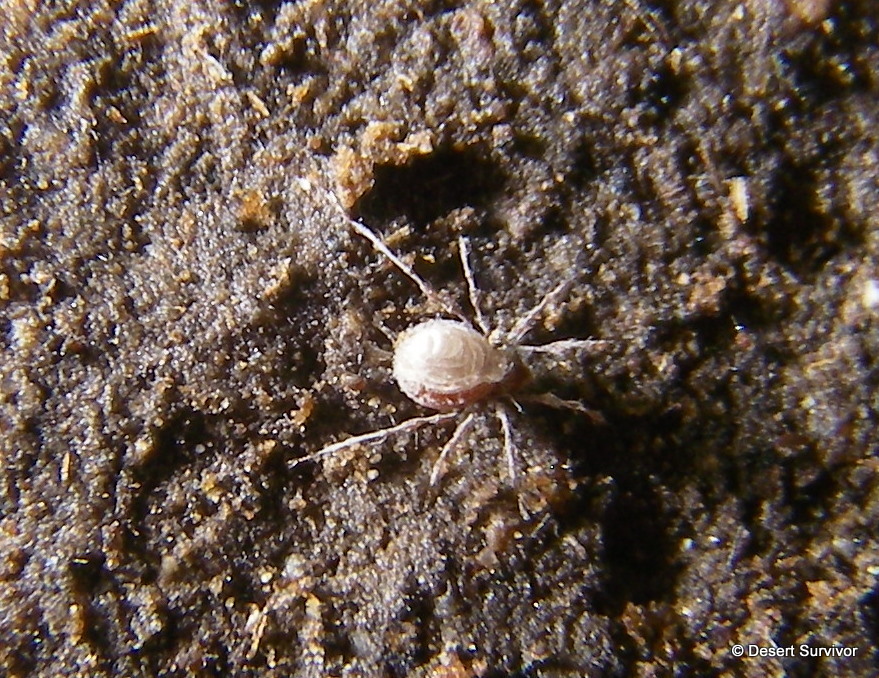
 There was also this little rose-colored creature, perhaps a mite.

 Here's a photo of David after the cave trip. Originally his entire cave suit was yellow.

 Jonathan exiting with a smile.

 And we all gasped when Jennie pulled down her cave suit to reveal a pristine National Park Service uniform shirt. She takes her uniform seriously!

The next day we went into another cave. (Okay, I know this post is getting long, but if I stop now, I won't get started again till next week! If you need a break, just stop here and come back in the next few days and read the rest.)
 I saw a couple ants at the bottom of the squeezy vertical entrance. It's so tight, though, that you don't use vertical gear, you just wedge yourself through it. Going down wasn't too bad.

 Numerous cave crickets hung out at the bottom of the drop along the walls and ceiling.

 We also saw several of these fungal beetles.

 This is David taking serious photographs. You can see some of his work by clicking here.

 We found lots of small bones in the cave, scattered in various locations.

 Nicole holding up a pelvis.

After we finished our trip in the walking portion of the cave, it was time to head out. That was easier said than done as we tried to shimmy up the tight vertical section. A piece of webbing helped a bit. Finally we all made it to the surface, although with a few new scrapes and bruises. I think most everyone sighed in relief to be back on top.

Sometimes I appreciate the sun a lot more after a caving trip!

Thursday, August 4, 2011

Bioblitz 2011!

 I've been out Bioblitzing the last few days, which has been awesome. Okay, Bioblitzing really isn't a verb, but it should be! A Bioblitz is a short event to document biodiversity.

This particular Bioblitz was to find Hymenoptera (bees, wasps, and ants) at Great Basin National Park. In addition to the scientific focus, the Bioblitz had a strong outreach/education component. Ranger Robb led an afternoon kids' hike to a harvester ant mound and explained it. The kids thought it was absolutely fascinating!

 In the evening graduate students studying Hymenoptera gave a campfire talk. They talked about their projects. Then they entertained the crowd by changing the song "Head, Shoulders, Knees and Toes" to "Head, Thorax, and Abdomen." They had everyone in the crowd do the movements. It was fantastic.

 It was a good turnout, and some of the folks at the campfire talk signed up to be Bioblitz participants the next day and spend some time searching. Two little boys even collected some ants on their bristlecone hike and turned them in.

 One really fun part about the Bioblitz was meeting the other participants. This is Sarah, and I loved her vial bag. I think it may have to become the next fashion accessory.

 Cecilia came from Brazil to study Hymenoptera at Utah State University, and Juanita came from Columbia.

 This is Ken, a retired entomologist who was so gracious sharing his knowledge. In another post I'll pass on some of what he taught me. His binoculars will focus on things only a couple feet away, giving a whole new dimension to insect watching.

 How do you like this bee?
If you say, That's not a bee, you're right. It only has two wings and no waist, which makes it a Diptera (which means two wings). Diptera are flies, and this fly's coloring imitates a bee.

 Students, visitors, and entomologists enjoying a patio talk by another graduate student.

 It was neat seeing the specimens being brought in. This couple had signed up at the campfire program to collect Hymenoptera. They came in so excited. They had found a few cool things. Plus, they said that the Bioblitz experience made them look at the national park in a whole new way. Their peripheral vision was expanded as they tried to locate the insects they might want to catch. And they realized that as they walked, they paid attention to things they had never really noticed before.

Just listening to them brought tears to my eyes. How cool to have a transforming experience and have your horizons broadened and be helping science at the same time!

 A school group from Colorado came and participated the second day, and Desert Boy couldn't resist joining them. With all those nets sweeping the vegetation, they were bound to find some neat things.

 They found this beautiful green wasp, a cuckoo wasp.

 Two of the students examine their catch.

 Here one transfers a find into the baggie. They were so professional, and even though it was the last field day of their 14-day trip, they went after the task with energy.

I sure want to go on a high school class trip like them!
 A big part of a Bioblitz is managing the data, and Sara helped enter the datasheets from the specimens coming in one morning. Even though it isn't one of the funnest tasks, Sara managed to have a big smile. She's going to go far.

 Near the end of the 48-hour collecting period, some of the experienced entomologists from the Nevada Department of Agriculture pulled out their microscopes to start sorting the specimens. So many were collected, especially from the light traps and malaise traps, that they wanted to make it a little easier for folks in the lab.

 Dr. James Pitts, the lead entomologist for the event, helped Becky preserve the specimens she had caught in her bowl traps--colored bowls filled with soapy water. She had a good number.

 Melissa made sure her datasheets were complete before she turned them in. She included a little of the vegetation in her sample, since some hymenopterans can be very particular about what vegetation they use.

 Grace and June were a delight to meet, as well as their fun mom. They did a super job collecting in various locations and I hope we get to spend more time with them!

 The Bioblitz was lucky to have two great sponsors, Western National Parks Association (WNPA) and the Great Basin National Park Foundation. They both provided lunches, at the beginning and end of the event. WNPA also provided some raffle prizes that made some of the participants extra happy.

 Apparently if you're an entomologist, you don't want to get far from your microscope, even if it is lunch time!

The event concluded with the preliminary results:
Over 60 participants
Over 160 collections brought in
Over 25 families of Hymenoptera added to the park list
Over 65 species of Hymenoptera added to the park list

Dr. Pitts and his students now have a big job of sorting, pinning, and identifying ahead of them. We can't wait to find out more about what was caught. They will undoubtedly add some families and many species to the tally. It may take a few (or many) months to process the thousands of specimens collected.

Well that's the quick overview. It was super fun and now I'm ready for a good rest.
If you ever have a chance to participate in a Bioblitz, I highly recommend it!
Related Posts Plugin for WordPress, Blogger...

blogger templates